An exploration of how millennia-old Hindu cosmology, ritual purity concepts, and the mythology of Lord Ayyappa underlie one of modern India’s most consequential legal battles.
A Temple at the Heart of Two Worlds
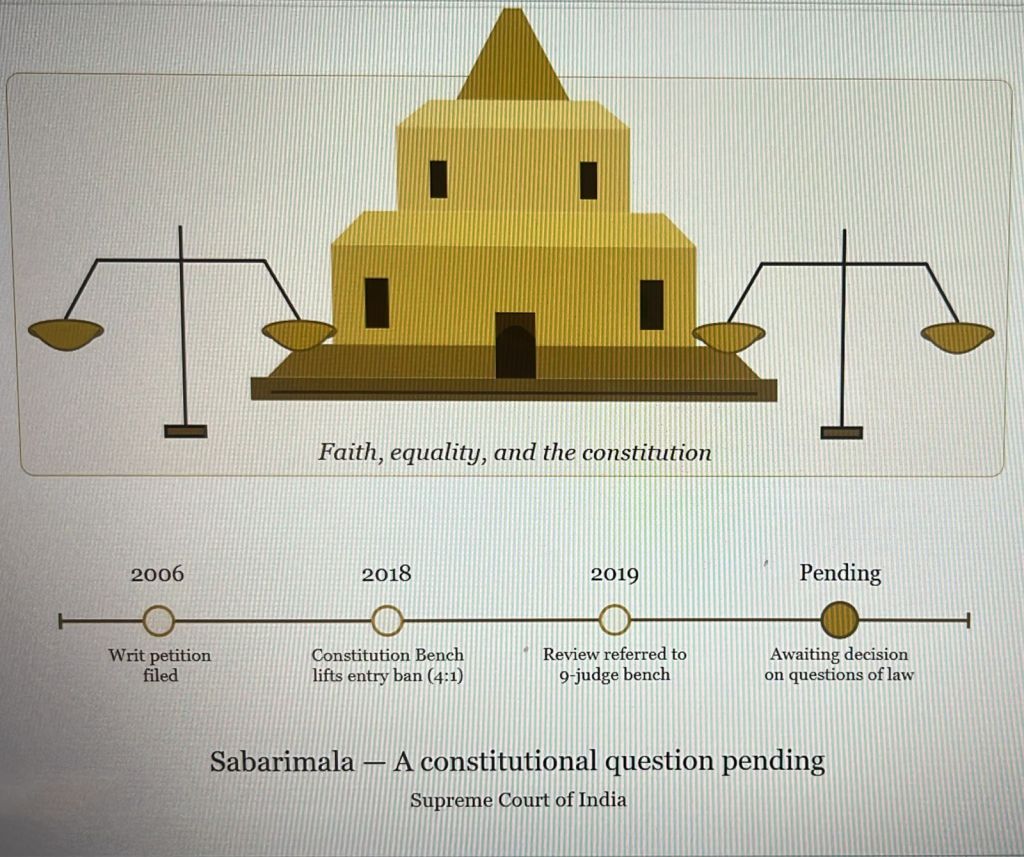
Nestled deep in the Periyar Tiger Reserve in the Western Ghats of Kerala, the Sabarimala Temple stands at the intersection of ecology and eternity. It is one of the largest annual pilgrimages on earth, drawing tens of millions of devotees who trek barefoot through forest trails, dressed in black or blue, chanting “Swamiye Saranam Ayyappa” — “I surrender to thee, O Lord Ayyappa.” Yet on September 28, 2018, this ancient hill shrine became the centre of India’s most charged constitutional debate: a five-judge bench of the Supreme Court, in a 4:1 majority, struck down the centuries-old tradition of excluding women of menstruating age (10–50 years) from entering the temple, declaring it unconstitutional.
The case — Indian Young Lawyers Association v. The State of Kerala — was not merely a legal dispute about temple entry. It was a collision between two deeply held worldviews: the constitutional vision of equality and individual liberty, and the ancient cosmological architecture of a living religious tradition. To understand the Sabarimala controversy is to understand both worlds.
The Deity and His Divine Origins
At the centre of everything stands Lord Ayyappa — or Dharmasastha, or Manikandan — a deity whose very origins embody paradox and synthesis.
According to Hindu scripture and regional folklore, Ayyappa was born of a union that defied the ordinary boundaries of cosmic order. The demoness Mahishi, sister of the slain Mahishasura, had secured a boon from Lord Brahma that only the offspring of both Lord Vishnu and Lord Shiva could destroy her. To fulfil this divine necessity, Vishnu incarnated as Mohini — the enchanting, illusory female form — and united with Shiva. From this extraordinary union was born Hariharaputra: the son of Hari (Vishnu) and Hara (Shiva). He was left as an infant on the banks of the Pamba River, where the childless King Rajashekhara of Pandalam discovered him, a jewelled bell (mani) around his neck, and named him Manikandan.
Scholars have noted that this mythology represents a conscious theological synthesis. Ruth Vanita, writing on Ayyappan’s origins, suggested the deity “probably emerged from the fusion of a Dravidian god of tribal provenance and the Puranic story of Shiva and Mohini’s interaction.” His very existence bridges Shaivism and Vaishnavism — the two dominant streams of Hindu practice — making him a rare ecumenical figure in a tradition defined by sectarian distinctions.
After vanquishing Mahishi and completing his earthly mission, Manikandan directed the king to build a shrine at Sabarimala in the deep forest. There, according to tradition, he chose the life of a Naisthika Brahmachari — an eternal celibate — dedicating himself to austerity, meditation, and the welfare of devotees. It is this foundational identity as a celibate deity that lies at the root of the temple’s ancient restriction on women of reproductive age.
The Ancient Architecture of Ritual Purity
To understand why the exclusion was practised, one must enter the conceptual universe of ancient Hindu ritual theory — a world in which the body is a site of sacred energy, and where different states of being carry different spiritual charges.
Classical Hindu thought, as codified in Dharmashastra texts, associates worship with a state of shaucha — purity at the physical, vital, and mental levels. This is not unique to Hinduism; nearly every ancient religious tradition tied access to sacred space to concepts of ritual cleanliness. The concern at Sabarimala was specifically linked to the celibate character of the deity: temple priests and traditionalists argued that the presence of women of menstruating age — symbols, in this cosmology, of active fertility — would disturb the ascetic spiritual atmosphere associated with Ayyappa’s vow of celibacy.
One traditional interpretation, articulated by some scholars of ritual energy, holds that menstruation represents a heightened state of prana (vital energy) — not pollution in a moral sense, but a powerful natural force whose presence might create an imbalance in the carefully maintained spiritual environment of a celibate deity’s shrine. A contrasting but equally ancient view, preserved in Tantric traditions, regards menstruation as so sacred that a menstruating woman is compared to a living goddess.
This duality is strikingly illustrated in comparative temple traditions. At the Kamakhya Temple in Assam, one of India’s most important Shakta shrines, the goddess herself is believed to menstruate annually. During the Ambubachi Mela, the temple is closed for three days in reverence to this sacred event, and the cloth placed over the deity’s stone form — reddened to represent menstrual blood — is distributed to devotees as a divine blessing. Elsewhere, the Chengannur Bhagavathy Temple in Kerala itself venerates the goddess’s menstruation as a sacred occurrence.
The ancient tradition, therefore, was not monolithic. It contained within itself both the reverence of feminine power and the restriction of its expression in specific ritual contexts associated with male celibate deities.
The Pilgrimage as Living Theology
The vratha — the 41-day austerity period observed by pilgrims before ascending to Sabarimala — is itself a form of embodied ancient theology. Devotees abstain from meat, alcohol, and sexual relations; they dress uniformly in black or blue; they wear a tulsi mala (sacred beads); they carry the irumudi kettu, a bundle of offerings on their head; and they address every fellow pilgrim as “Swami” — recognising the divine in one another.
This ritual practice dissolves the ordinary social distinctions of caste, class, and region. Scholars have noted that Sabarimala has historically functioned as one of Hinduism’s most radically egalitarian spaces, where a Brahmin and a Dalit climb the same hill, chant the same names, and prostrate before the same deity. The tradition also has a striking interfaith dimension: uniquely among Hindu pilgrimage sites, Sabarimala includes a dargah (Muslim shrine) for Vavar, believed to have been a close companion of Ayyappa in legend, reflecting the syncretic cultural history of Kerala.
The question the 2018 Supreme Court case forced into the open was whether this ancient architecture of equality could coexist with a gender-based exclusion — or whether the exclusion was itself a distortion of the tradition’s deeper ethos.
The Legal Battle: Constitutional Morality vs. Religious Autonomy
The petition was first filed in 2006 by the Indian Young Lawyers Association, arguing that the ban on women aged 10 to 50 violated the fundamental right to equality (Article 14), the prohibition on discrimination (Article 15), the abolition of untouchability (Article 17), and the right to freedom of religion (Article 25). The Travancore Devaswom Board, which manages the temple, defended the restriction as an essential religious practice protected under Article 26, which guarantees religious denominations the right to manage their own affairs.
The majority — Chief Justice Dipak Misra, and Justices A.M. Khanwilkar, R.F. Nariman, and D.Y. Chandrachud — held that the exclusion could not qualify as an “essential religious practice,” noting that no scriptural evidence had been placed before the court demonstrating that the exclusion of women was so fundamental to the religion that it could not survive without it. Justice Chandrachud went further, arguing that any social exclusion grounded in notions of biological “purity” fell within the vast ambit of Article 17’s prohibition on untouchability.
The lone dissent came from Justice Indu Malhotra, whose opinion has attracted significant scholarly attention. She argued that in a pluralistic, secular democracy, courts must exercise restraint in adjudicating matters of religious faith and practice. Her dissent contended that what might appear irrational or illogical from the outside may carry deep meaning within the internal life of a religious community — and that the Constitution’s guarantee of religious freedom was not conditional on practices meeting a standard of rationality.
The court’s majority responded with the doctrine of “constitutional morality” — the idea that the Constitution’s values of dignity, equality, and non-discrimination must prevail over what they termed “popular morality” derived from social custom.
Ancient Belief in a Modern Frame
The Sabarimala case laid bare a tension that runs through the long history of Indian civilisation: the relationship between codified law and living tradition. Ancient India was not unfamiliar with reform. The texts of Manusmriti were themselves contested within the tradition; Bhakti movements of the medieval period challenged brahminical exclusions; and regional devotional traditions often absorbed and transformed older restrictions.
What the Supreme Court did in 2018 was to apply the 20th-century instrument of constitutional law to a question that ancient traditions had answered through theological reasoning. The majority found that the constitutional framework — framed after centuries of reform movements including those of Raja Ram Mohan Roy, Jyotiba Phule, and B.R. Ambedkar — demanded a different answer than ancient custom had given.
The case also set a broader precedent. The 2019 referral of the judgment to a nine-judge bench — alongside questions about female entry into mosques, and the practice of female genital mutilation among a Shia Muslim community — reflected how the Sabarimala case had opened a jurisprudential window into the relationship between religious practice and fundamental rights across India’s faith traditions.
Two Streams, One River
The Sabarimala controversy cannot be resolved by simply declaring one side right and the other wrong. Its depth lies precisely in the fact that both sides draw on genuine and ancient sources of authority: one from the constitutional revolution that gave India its founding framework of rights; the other from a tradition of theological reasoning stretching back thousands of years.
Lord Ayyappa himself, in the mythology that gave birth to this sacred site, is a figure born of the union of opposites — Vishnu and Shiva, preservation and transformation, masculine and feminine. His legend encodes the ancient Hindu insight that apparent contradictions can be held within a larger unity. The challenge the Sabarimala case poses to contemporary India is not unlike the challenge that his very birth posed to the cosmic order: to find, in the meeting of opposing forces, not destruction, but a new and higher synthesis.
As the nine-judge bench deliberates — with the 2018 verdict technically in effect — the forests of the Western Ghats continue to receive millions of pilgrims. They climb in silence and in chant, carrying their burdens, seeking their god, and walking — as pilgrims have always walked — between the world as it is, and the world as they believe it ought to be.
This article draws on the Supreme Court’s judgment in Indian Young Lawyers Association v. The State of Kerala (2018), Kerala Tourism’s official account of Sabarimala mythology, the Supreme Court Observer’s case analysis, and scholarship on Hindu ritual traditions and menstruation published in peer-reviewed and academic sources.
 legalsadhana.com
Leave a comment