The Three-Year Practice Rule for Judicial Services: A Pendulum That Never Quite Settles
An editorial tracing the historical arc of an unresolved debate, from the Setalvad Commission of 1958 to the Supreme Court’s 2025 reinstatement and the ongoing reconsideration of 2026.
Introduction
Few questions in Indian judicial reform have oscillated as violently as this one: should a fresh law graduate be permitted to sit a judicial services examination, or must they first cut their teeth at the Bar? In May 2025, a three-judge Bench of the Supreme Court — speaking through Chief Justice B.R. Gavai and Justices A.G. Masih and K. Vinod Chandran — answered that question in the affirmative, reinstating a minimum of three years of legal practice as a prerequisite for entry into subordinate judicial services. The judgment in All India Judges Association v. Union of India, 2025 SCC OnLine SC 1184, has since triggered a wave of litigation, academic critique, and a fresh reference back to the very Court that delivered it. As of April 2026, the rule’s future is once again under active reconsideration.
To understand why this question refuses to die, one must trace its history with care. The story of the three-year rule is, in many ways, the story of the Indian judiciary’s enduring discomfort with the trade-off between practical exposure and inclusive access — between the seasoned advocate and the brilliant graduate, between the courtroom and the classroom.
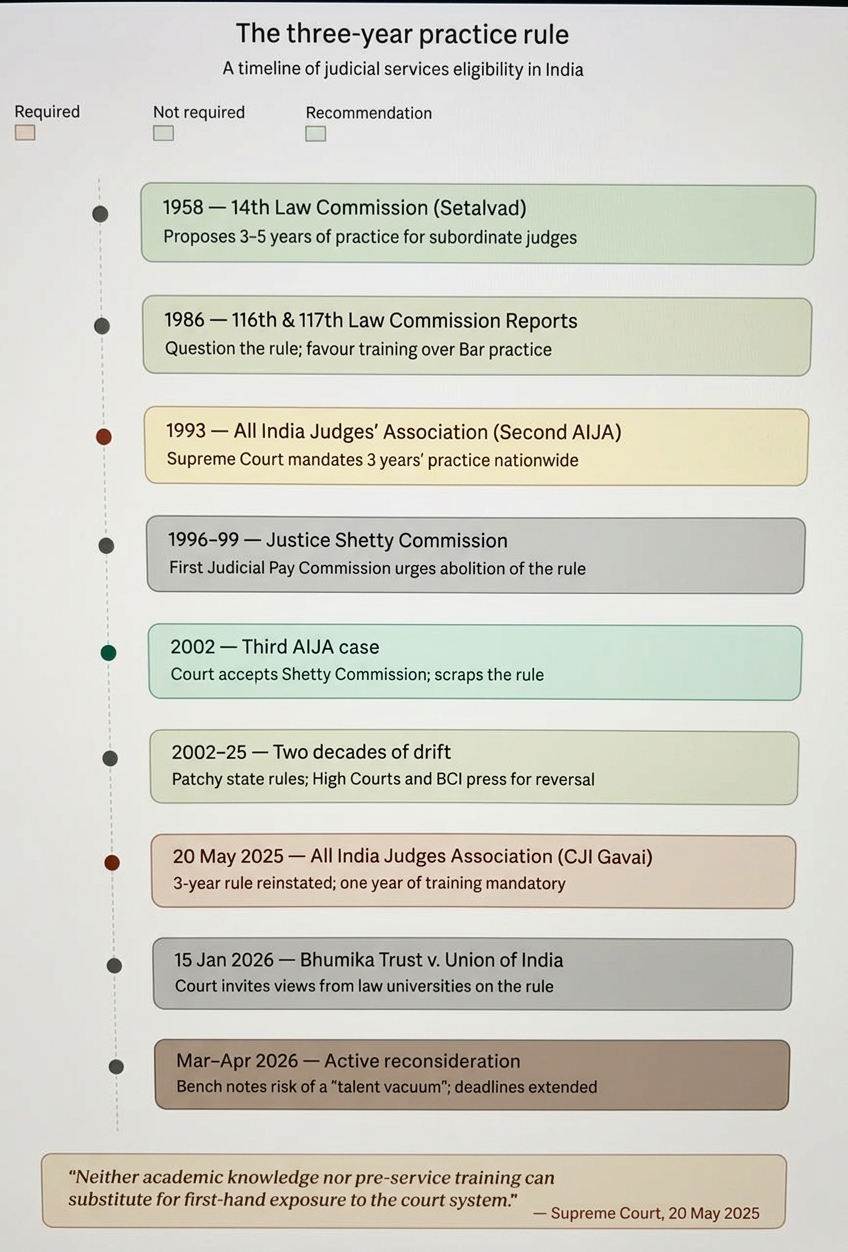
I. The Setalvad Vision: The 14th Law Commission Report (1958)
The earliest formal articulation of the practice requirement can be traced to the 14th Report of the Law Commission of India (1958), chaired by Shri M.C. Setalvad. The Commission contemplated that persons with three to five years of practice should be eligible to compete for posts of subordinate judges. Crucially, however, the Commission did not see practice as a mechanical filter. It paired the recommendation with a vision of a substantive examination — one that tested drafting, appreciation of evidence, and judgment writing rather than rote memorisation. It also proposed an All India Judicial Service to recruit talent at the highest level.
It is worth pausing here. The Setalvad recommendation was anchored in a particular historical context. In 1958, the LL.B. was a two-year degree taken after graduation, with little or no clinical training. Practice at the Bar was the only practical exposure most graduates would ever receive. The rationale for the three-year rule, in other words, was specific to the legal education of its time.
II. The Law Commission Reports of the 1980s
By the 1980s, the picture had begun to shift. Three Law Commission Reports — the 116th, 117th, and 118th — examined the question afresh, and they did not speak with one voice.
- The 116th Report recommended abolishing the three-year rule, observing that two or three years of unsupervised practice did not, in itself, equip a person to be a competent judge.
- The 117th Report (1986) went further. It declared it “wholly unsustainable” to assume that mere standing at the Bar produced the experience necessary for judicial office. The Report argued that two years of intensive, structured post-selection training would outweigh whatever advantage three years of Bar practice could offer. It supported direct recruitment of fresh graduates, with rigorous induction training as the corrective.
- The 118th Report, while acknowledging that the requirement was not strictly essential, took a more cautious view and suggested that the three-year rule could be retained.
This divergence within the Commission’s own reports prefigured the divergence that would later mark the Supreme Court’s own jurisprudence on the question.
III. The First Reversal: All India Judges’ Association (1993)
The matter reached the Supreme Court in All India Judges’ Association v. Union of India, (1993) 4 SCC 288 — popularly known as the Second AIJA case. Surveying the field, the Court directed all States to prescribe three years of practice as an essential qualification for recruitment to the lowest rung of the subordinate judiciary. The reasoning was straightforward: vesting a fresh law graduate with the formidable powers of a magistrate, without any exposure to the rhythms of a courtroom, was neither prudent nor desirable.
For nearly a decade, this was the law of the land.
IV. The Shetty Commission and the Second Reversal (2002)
In 1996, the Government of India constituted the First National Judicial Pay Commission under the chairmanship of Justice K. Jagannatha Shetty. The Commission’s terms of reference were broad — service conditions, pay structures, and the larger health of the subordinate judiciary — but its observations on the three-year rule proved to be the most consequential.
The Shetty Commission’s findings were unequivocal. After a wide-ranging consultation, it concluded that:
- The three-year rule had failed to attract the best legal talent to judicial service. Bright graduates, after three years of often poorly remunerated practice, found judicial salaries unattractive when compared to corporate or chamber alternatives.
- The advent of the five-year integrated law degree, with its clinical components, internships, and moot court training, had rendered the original justification for the three-year rule obsolete. Graduates of institutions like the National Law Universities were, in many respects, better prepared than junior advocates of three years’ standing.
- The “starvation period” of early practice — in which juniors typically earn token stipends — was driving away first-generation lawyers and candidates from socio-economically marginalised backgrounds.
- A robust induction training programme, of one to two years, would more reliably produce competent judicial officers than an unsupervised stint at the Bar.
In All India Judges’ Association v. Union of India, (2002) 4 SCC 247 — the Third AIJA case — the Supreme Court accepted these recommendations and abolished the three-year requirement. In a frank admission, the Court acknowledged that “the best talent which is available is not attracted to the Judicial Service.” States were directed to amend their rules accordingly, and to put in place the structured training that the Commission had envisioned.
V. Two Decades of Drift
The 2002 dispensation, however, never entirely held. While the Supreme Court had abolished the rule, its implementation remained patchy. Several High Courts, in their respective recruitment notifications, reintroduced practice requirements through the back door — sometimes formally, sometimes through age criteria that effectively excluded fresh graduates. Across states, the eligibility landscape became a patchwork. Some states required no practice at all. Others required two or three years. Still others added preferences that functioned as soft exclusions.
Meanwhile, complaints from sitting judges of the higher judiciary mounted. A growing chorus of High Courts wrote to the Supreme Court expressing concern about the courtroom readiness of fresh recruits. The Bar Council of India, too, filed an application seeking the reinstatement of the practice requirement, arguing that judicial officers without prior Bar experience struggled to manage proceedings, appreciate advocacy, and command the confidence of the litigating public.
This pressure, building over nearly two decades, set the stage for the 2025 reversal.
VI. The 2025 Judgment: A Return to First Principles?
On 20 May 2025, in All India Judges Association v. Union of India, 2025 SCC OnLine SC 1184, a three-judge Bench led by Chief Justice B.R. Gavai reinstated the three-year practice requirement. The principal directions were as follows:
- Mandatory three-year practice. No candidate may sit the Civil Judge (Junior Division) examination without three years of practice as an advocate. The period is to be reckoned from the date of provisional enrolment, not from the date of clearing the All India Bar Examination.
- Certification. The candidate’s practice must be certified by an advocate of at least ten years’ standing, with appropriate endorsement by the Principal Judicial Officer of the station. For those practising in the High Courts or the Supreme Court, certification by a Senior Advocate, with endorsement by a designated officer, is required.
- Law clerks included. In a measured concession, the Court held that experience as a law clerk to a judge will count towards the three-year requirement — recognising that clerkships offer a distinct but valuable form of practical exposure.
- One-year mandatory training. Every selected candidate must undergo at least one year of post-selection training before being permitted to preside over a court.
- Prospective application. The rule applies prospectively. Recruitment processes already notified before 20 May 2025 are unaffected.
The Court’s rationale, distilled, was this: judicial officers handle questions of life, liberty, and property from their very first day in office. Neither academic knowledge nor pre-service training, the Bench held, could substitute for first-hand exposure to the texture of courtroom life — the rhythms of examination-in-chief, the practical realities of bail, the unwritten conventions of the Bar.
A subsequent clarificatory order, reported in late 2025, confirmed that judicial officers appointed before 20 May 2025 would not be required to satisfy the three-year condition if they applied for judicial services in another State — an important relief for in-service officers seeking inter-state mobility.
VII. The Critique: An Editorial Assessment
The 2025 judgment has not been received without resistance. Three lines of critique merit serious engagement.
(a) The empirical vacuum
It is a striking feature of the 2025 judgment that no rigorous empirical evidence was placed before the Court establishing that fresh graduates, as a class, perform worse than three-year practitioners on the bench. The Court relied substantially on impressions conveyed by the High Courts. As more than one commentator has observed, this is a curious foundation for a rule that excludes an entire cohort of aspirants. The Shetty Commission, by contrast, had conducted an exhaustive consultative exercise. The 2025 record is comparatively thin.
(b) The problem of indirect discrimination
The most serious concern is structural. Three years of practice in the lower courts is, for most juniors, a period of severe financial precarity. Stipends, where they exist at all, typically range between ₹10,000 and ₹20,000 per month — often less in mofussil practice. Law school graduates carrying education loans of ₹12 to ₹20 lakh from five-year integrated programmes simply cannot afford to subsidise themselves through this period.
The consequence is predictable. The three-year rule operates as a structural filter that disproportionately excludes candidates from economically disadvantaged backgrounds, first-generation lawyers, and women — the latter often facing the additional burdens of late-hour litigation work, travel, and a male-dominated chamber culture. This is the textbook definition of indirect discrimination: a facially neutral rule that systematically disadvantages an identifiable group. The judiciary, of all institutions, ought to be alive to that distinction.
(c) Inconsistency with comparable services
A young graduate of twenty-one or twenty-two is considered fit, after the Civil Services Examination and a year at the Lal Bahadur Shastri National Academy, to assume charge as a Sub-Divisional Magistrate — wielding revenue, magisterial, and administrative powers of considerable scope. It is difficult to articulate, in principled terms, why the same age cohort should be deemed unfit for the Civil Judge (Junior Division) when supported by an equivalent or longer period of structured training. The asymmetry is not obviously defensible.
VIII. The 2026 Reconsideration
By early 2026, the disquiet had translated into formal proceedings. In Bhumika Trust v. Union of India, the Supreme Court, by order dated 15 January 2026, directed all law universities and National Law Schools to submit their views on the practice requirement. NALSAR, NLSIU, and several other institutions have since filed detailed responses, broadly favouring abolition or substantial modification, and proposing a structured alternative: extended post-selection training of two years, paid judicial clerkships at the District Court level, and reform of the examination itself to test practical competence directly.
In a hearing reported on 19 March 2026, the Bench, led by the Chief Justice, observed that a rigid mandate risks creating a “talent vacuum” and indicated openness to reconsidering the 2025 position. Application deadlines for the current cycle have been extended to 30 April 2026 to accommodate the ongoing deliberations.
The pendulum, in other words, may yet swing once more.
IX. The Way Forward
Two propositions emerge from this long history.
First, the Court’s instinct in 2025 — that judicial officers ought to possess practical exposure to the courtroom — is not wrong. Where it errs is in treating three years of unstructured, unsupervised, often unpaid Bar practice as the only acceptable mode of acquiring that exposure. There are alternatives, and they are better.
Second, any sustainable settlement must take seriously what the Shetty Commission grasped clearly: that legal education in India has changed, that the costs of becoming a lawyer have risen sharply, and that any eligibility rule which assumes a candidate can absorb three years of penury is, in 2026, a class barrier dressed as a competence requirement.
A workable framework would likely combine the following elements:
- Extended, rigorous, paid post-selection training of eighteen months to two years, with components on judgment writing, procedural law, judicial ethics, and supervised court attachments — substantively reviving what the 117th Law Commission proposed.
- Structured paid judicial clerkships at the District Court level, recognised formally as an alternative pathway to the Bar route.
- Reform of the examination itself to test practical competence — drafting, evidence appreciation, judgment writing — as the 14th Law Commission had originally envisaged in 1958, but which most state examinations still neglect.
- A grandfathering and transition framework that protects the legitimate expectations of candidates already in the pipeline.
Conclusion
The three-year practice rule is, at bottom, a debate about how the Indian republic chooses its judges. The Supreme Court has now answered the question one way in 1993, the opposite way in 2002, and the original way again in 2025 — with a fresh reconsideration unfolding even as this is written. The inconsistency is not merely judicial; it reflects an institutional ambivalence that the Court has not yet found a way to resolve.
What is needed is not another reversal but a settlement — one that honours the genuine concern for courtroom readiness without converting that concern into a tax on the poor. The Setalvad Commission understood, almost seventy years ago, that the real question was never simply about practice. It was about whether the examination, the training, and the conditions of service were equal to the dignity of the office. That question remains open.
Until it is answered, the pendulum will keep swinging. And every swing exacts a cost — paid, almost invariably, by the young aspirants who are simply trying to enter a profession that cannot decide what it expects of them.
The author writes on questions of constitutional and judicial reform. Views expressed are personal and are intended for academic and editorial discussion. This article does not constitute legal advice.
Suggested categories: Editorials · Constitutional Law · Judicial Reform Suggested tags: All India Judges Association, three-year rule, judicial services, Shetty Commission, Law Commission, judicial reform, Article 14, B.R. Gavai
 legalsadhana.com
Leave a comment